
Chautauqua County Deed Records and What They Show
Keep your working notes tight. Record the parcel number and the municipality. Also note the source date and the exact label on the record. Then confirm everything with the office that holds the original. A map, an assessment entry, or an index line from Chautauqua County portals is a lead. It is not proof. Certified instruments, licensed surveys, and title examinations settle the question.
| Deed Type | What It Does | Common Use |
|---|---|---|
| Warranty deed | Full ownership with guarantees | Standard sales |
| Quitclaim deed | Transfers whatever interest exists | Family, divorce, cleanup |
| Grant / special warranty | Limited guarantees | Some sales, New York custom |
| Trustee / executor deed | Transfer from an estate or trust | Probate, foreclosure |
| Tax deed | Transfer after a tax sale | Delinquent-tax properties |
Good habits keep a Chautauqua County deed search honest. Save the parcel identifier and municipality. Note the date of the record and its precise title, because those small details let someone else retrace your steps. Portals point you in the right direction. Still, only the county clerk's certified instrument, a licensed survey, or a title examination settles the question.
The Chautauqua County Grantor-Grantee Index
The grantor-grantee index rewards careful notes. In Chautauqua County, record the parcel identifier, the town or city, the date, and the exact index label every time you pull an entry. Online screens move fast. But a confident answer comes from the office that holds the underlying record, not from a portal result alone.
- find the current owner's purchase deed (owner as grantee)
- read the prior owner (the grantor) from that deed
- search that prior owner as grantee to step back again
- note the online cutoff; go to deed books for earlier years
- Grantor
- The party transferring - the seller.
- Grantee
- The party receiving - the buyer.
- Chain of title
- The ordered sequence of deeds for a property.
- Book/Page vs Instrument #
- How Chautauqua County references a recorded document.
Getting a Copy of a Chautauqua County Deed
Ordering a copy? Gather your facts first. Chautauqua County staff will ask for the parcel number, the municipality, and the record date, so have those ready along with the exact label you saw. Portal searches are a starting point. A certified copy from the recording office is what you can actually rely on for legal use.
Recorded, not guaranteed. Use public records for lawful parcel research and verify the result with the responsible custodian; never use owner information to harass or harm anyone.
Chautauqua County Deed Records Begin in 1811
Chautauqua County deed records run deep. The Clerk's historical guide covers deeds, mortgages, and discharges from 1811 forward, indexed by grantor, grantee, mortgagee, and mortgagor. SearchIQS serves as the online subscription gateway. The public screen shows no stated image cutoff year, so treat coverage as unconfirmed rather than assuming a date. For anything the gateway cannot settle, the Clerk's office and research room in Mayville hold the older books.
Copies follow the county's published fee schedule. A recorded copy costs $1 per page. Filing copies carry a $4 minimum, and card transactions of $20 or more add a 2.5 percent processing charge. When you contact staff, give the property address, parcel or SWIS key, party names, an estimated year, the instrument type, and any book or page you already have. Ask what form the result takes. It might be an index entry, an image, microfilm, or a staff retrieval.
Use the Chautauqua County Clerk Land-Recording Route
The official County Clerk land-recording page names the custodian for deeds, mortgages, and recorded maps.
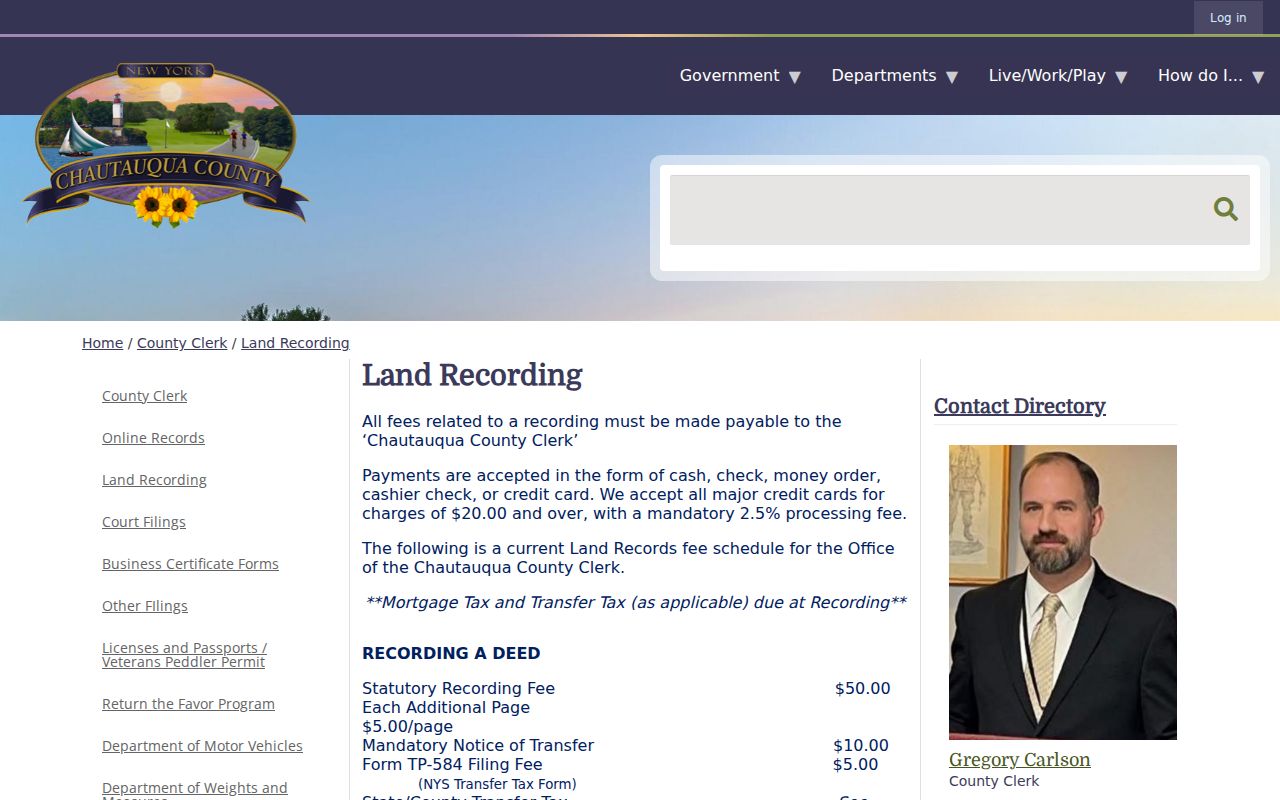
That page is the authoritative route to the office. SearchIQS is just the remote index. When you need a certified or relied-on copy, confirm the instrument reference and current copy procedure with the Clerk at 3 North Erie Street in Mayville.
Search the Chautauqua County Grantor-Grantee Chain
Start with the current parcel report. Find the newest recorded deed. The grantee received the property; the grantor gave it up. Write down the instrument type, the recording date, the book and page or index reference, any meaningful consideration, and the full legal description. Next, hunt for that same grantor as a grantee in an earlier period. This shows how the property was acquired. Repeat the sequence step by step. That discipline builds a backward chain instead of a surname-hopping guess.
The Clerk's guide dates deeds, mortgages, and discharges from 1811 to the present. Indexing runs under grantee, grantor, mortgagee, and mortgagor. It also warns that some nineteenth-century transfers never got recorded. When a link is missing, work around it. Compare map names, adjoining owners, historical assessments, and probate authority. Also check later deeds that repeat an earlier legal description. Mark the gap as unresolved until an instrument or solid title evidence closes it.
SearchIQS remains the remote subscription portal. Its public gateway does not state exact image years or show every search control. Older books, index-only entries, and gateway-restricted records belong to the County Clerk office and the Mayville research room. Skip guessing at an online cutoff.
Distinguish Chautauqua County Deed Types
A deed transfers an interest. A mortgage secures a debt. A discharge or satisfaction releases it. All three can live in the same Chautauqua County land-record system. Yet each answers a different question. A warranty-style deed carries different assurances than a quitclaim. A fiduciary, referee, or tax deed reflects the specific authority named in the instrument itself. Keep the exact caption. Relabeling everything a sale deed destroys the record's meaning.
Estate ownership may pass through a Surrogate's Court file. It can become an executor or administrator deed. WebSurrogate offers party, date, and file leads, though unrestricted access to documents filed before February 19, 2014 may require public computers. Foreclosure work can pull in a notice of pendency, a judgment, and a sale. It can also produce a referee deed. The court events explain the authority. The later recorded instrument is what ties those events to the land-record chain.
Be careful with price. A nominal or missing consideration says nothing about market value. Family transfers, partial interests, and estate deals rarely resemble open-market sales. Use the deed for parties and legal description. Use the roll for assessment, and sale fields only as dated context.
Connect a Chautauqua County Deed to Its Map
Recorded maps in Chautauqua County go back to 1821. The Clerk indexes them by town and map name. Almost all are scanned. You can view them on public-access computers in the office. A strong map request names the municipality, the map or development, lot and block, a nearby road, an approximate filing year, and any book and page copied from the deed. The plat you get back can explain a lot reference. The modern street address simply does not. The county GIS map is the other half of the picture. It shows current tax geometry with section, subsection, block, lot, sublot, suffix, and great-lot context. Treat it as a research bridge rather than a recorded survey. Parcel lines may be generalized or shifted against imagery. Before relying on a deed call, easement, or boundary, confirm through the recorded instrument and proper survey evidence.
Older property rewards careful bookkeeping. Preserve the full trail from deed book and page to map name, historic lot description, old parcel key, new formatted parcel ID, and PHD key. Street names and house numbers change over time. That layered reference trail keeps the same land recognizable across record systems.
Order a Chautauqua County Deed Copy
Chautauqua County deed copies are inexpensive. The County Clerk charges $1 per page for recording copies. Filing copies run $1 per page. A $4 minimum applies, and certified and uncertified copies carry the same fee in that copy context. Card transactions of $20 or more add a 2.5 percent processing charge. Verify the current fee and your certification needs before paying.
When you order, give the office real detail. Give the address, parcel, and SWIS keys. Also include grantor and grantee, approximate recording year, instrument type, and any known reference. Ask staff to confirm the page count, certification, delivery method, and total cost. An address is only an intake clue. The legal description matters most here. The named parties distinguish the correct instrument in the deed records.
A copy proves what the document says and that it was recorded. It is not a title opinion. Easements, restrictions, mortgages, and judgments may lie outside it. Later transfers or an unrecorded interest may also require a broader examination. The conclusion may support a purchase, financing, or a boundary dispute. In those cases use a qualified title professional.
The Mayville research room helps when a deed description predates the current map. Its holdings include state census material from 1825 through 1925. Tax assessments run from 1854 through 1934. Naturalizations, court records, and other historical series round out the collection. Jamestown directories from 1905-06, 1909-10, and 1911-12 can tie a historic name to a street. Directory evidence is not title evidence, though. Use it for spelling, address, and occupation clues. Then return to the grantor-grantee index, the recorded map, and the deed book for any ownership conclusion. A gap that survives those checks should stay labeled as a gap.
Note: Retain the complete recording reference, access date, and source with every deed finding.