
How to Find Who Owns a Chautauqua County Property
Save the details that matter when you track down a Chautauqua County owner of record. Jot down the parcel number and the municipality. Also note the record label and the date you saw it. Those specifics make it far easier to confirm your find. The office that actually holds the deed records can verify it. A parcel from the assessor roll or a GIS map is a strong lead. But only a certified instrument, licensed survey, or full title examination settles the question of who truly owns the property.
- search the address in the Chautauqua County Property Tax Lookup for the owner of record
- confirm on the latest recorded deed in the County Clerk land-record index
- if owned by an LLC or trust, look up the entity with the Secretary of State
- use the owner's mailing address on the tax roll to reach them
Where Chautauqua County Owner Information Comes From
Write down the parcel identifier every time. A Chautauqua County ownership search is only as strong as the details you keep with it, so save the municipality, the source date, and the exact record label alongside each result. Official portals are good leads. Still, an index entry, an assessment line, or a map pin never replaces a certified instrument, a licensed survey, or a full title examination, so confirm with the office that keeps the record.
| Source | Owner Info It Gives | Access |
|---|---|---|
| Assessor / tax roll | Owner of record, mailing address | Free portal |
| Recorder deed index | Grantee on the latest deed | Index free |
| Secretary of State | LLC/entity officers and agent | Free |
| GIS parcel viewer | Owner name per parcel | Free viewer |
Details make a lookup stick. When you trace a Chautauqua County owner, hold onto the parcel number, the municipality, and the date on the record. Also keep the label the office itself uses. Confirming with the recorder or assessor prevents small mismatches from becoming big ones. Portals point you in the right direction. But a parcel map or assessment entry is a lead, not a certified deed.
What "Who Owns This Property" Cannot Tell You
An ownership answer has limits. A Chautauqua County parcel report names the owner of record on the tax roll, yet it cannot show every beneficial interest, every occupant, or every person receiving mail at the property. Public indexes are starting points. When legal ownership matters, a title examination or licensed survey, not a search result, is the instrument to rely on.
Lawful use. Use public records for lawful parcel research and verify the result with the responsible custodian; never use owner information to harass or harm anyone.
Resolve Who Owns Chautauqua County Property With Two Dates
The PHD field labeled Current Owner answers the roll-side question. Save it with its roll year and visible update date. Then pull the newest County Clerk deed and compare grantee, recording date, and legal description. If the two disagree after a recent closing, report both dates plainly. A deed can be newer than the assessment roll. An owner label can also reflect tax administration rather than a legal title opinion. The dates tell you which voice you are hearing. Keep owner, mailing address, and situs as three separate fields. A mailing address is where tax notices go. It may belong to an entity, an agent, a care-of recipient, or a post office box. It does not establish occupancy. Trusts, estates, and limited liability companies need their exact recorded style. Add an estate file or a New York Department of State entity check when relevant.
See the Chautauqua County Current-Owner Evidence
The county's PHD parcel report shows how ownership history and deed-reference links attach to a selected parcel. It is one parcel's paper trail, laid out field by field.
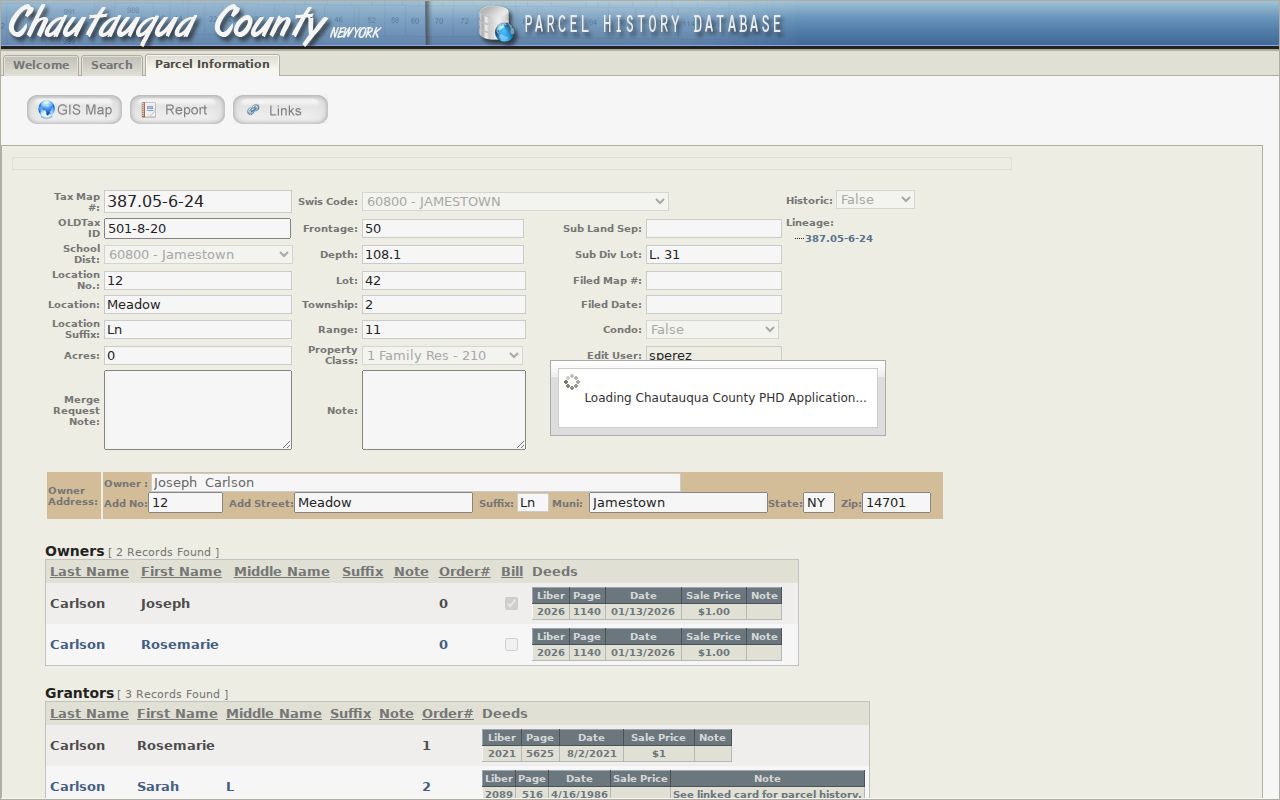
Use the parcel identifier in the report. That number keeps you from merging two Chautauqua County owners who happen to share a name, and it links the report to the recorded instrument. Treat the report as a lead, never as a substitute for a full title search.
Follow the Chautauqua County Owner-Finding Sequence
Start with the address in PHD or the Parcel Viewer. Review the close matches and pick the parcel by municipality and geometry. Save the formatted parcel ID, the old key, and the SWIS code. Also save the Current Owner and the roll year. Then carry that parcel and owner spelling into the County Clerk land-record index. The newest deed should match the land through its legal description. It should not rely on just a similar street address. Compare the deed's grantee and recording date against the administrative owner field. Compare it also against the field's displayed update date. A recent deed can outrun the annual roll. A parcel report may carry a page-level timestamp that says nothing about every field. When they differ, state both sources and dates. Then ask the Clerk or assessor rather than silently picking one. This sequence answers who the public records name as owner. It does not surface every beneficial interest, occupant, or mail recipient. Some ownership must stand beyond the public research trail. For those cases, a title professional is the right call.
Handle Trust, Estate and Entity Owners
Search the exact owner style the parcel report and deed use. A trust may name its trustees. An estate transfer may name an executor or administrator. An LLC may hold title under its registered entity name. Shortening the name can merge separate parties into one. Keep the style exact. For an entity, New York's Department of State database can verify the legal name. It can also verify public status information. It does not prove an officer or agent personally owns the parcel. For an estate, WebSurrogate can supply a file and party trail. The fiduciary deed connects authority to the property. Older unrestricted documents may require public-computer access, especially for filings before February 19, 2014. Record only what explains ownership. That means the entity or fiduciary name, the instrument, the date, the parcel, and the legal description. Skip signatures, account data, protected addresses, and unrelated personal details.
Keep Mailing Address, Situs and Occupancy Separate
A situs address tells you where the parcel sits. The mailing address tells you where tax bills travel. That second field may point to a post office box. It may also hold a care-of line, a lawyer, a business office, or a home in another state. Neither one proves who lives in the building. Reading an owner of record label as a census of residents is a mistake. Chautauqua County records make no such claim anyway.
New York runs an Address Confidentiality Program. It substitutes a safe address and forwards the mail. When a Chautauqua County property records search turns up that kind of mismatch, treat it as a privacy line rather than a riddle to crack. Pull only the fields your parcel research needs. If a deed or tax roll entry needs fixing, ask the custodian of that record.
Owner names serve title work, purchase diligence, boundary notices, and tax questions. They must never be used to stalk or harass anyone. Whatever conclusion you rely on, confirm it with the County Clerk, the local assessor, or a qualified professional before acting on it.