
Tracing Former Owners of a Chautauqua County Property
Old ownership questions rarely end at the first result. A Chautauqua County parcel number, the municipality and the source date should travel with every note you keep. Exact record labels matter too. Then take the finding back to the office that keeps the record and confirm it there, because a portal lead is not a certified instrument, a licensed survey or a title examination.
| Source | Years It Covers | Where Held | What It Shows |
|---|---|---|---|
| RECORDER DEED INDEX | YYYY-present | RECORDER / PORTAL | Owners and sale dates |
| MICROFILM DEED BOOKS | YYYY-YYYY | RECORDER VAULT | Earlier owners |
| HISTORIC PLATS | YYYY-YYYY | SURVEYOR / ARCHIVES | Subdivision and lot history |
| OLD TAX ROLLS | YYYY-YYYY | ARCHIVES / LIBRARY | Owners of record by year |
Write down more than a name. In Chautauqua County, a former-owner search goes best when each result carries the parcel identifier, municipality, source date and the exact record label used by the office. Maps and assessment indexes are strong leads. Only the keeper of the underlying record can confirm what an entry really means, and no portal display substitutes for a certified instrument, survey or title examination.
Walking the Chautauqua County Deed Chain Backward
A deed chain only holds together when the details hold together. For Chautauqua County work, log the parcel identifier, the municipality and the date of each source. Also record the exact label on the record itself. Then verify with the office holding the file. An index entry or map may point the way. But it cannot replace a certified instrument, a licensed survey or a title examination.
- find the current owner's purchase deed (owner as grantee)
- read the prior owner (the grantor) from that deed
- search that prior owner as grantee to step back again
- note the online cutoff; continue in the deed books for earlier years
- Grantor / grantee
- Seller / buyer on a deed.
- Chain of title
- The ordered sequence of past deeds.
- Legal description
- Why it beats the street address for old records.
How Far Back Chautauqua County Ownership Records Go
History hides in small details. Tracing ownership across Chautauqua County means pairing each parcel number and municipality with the source date and the precise record label an office used. That discipline pays off when a grantor's name shifts spelling between decades. Confirm the final answer with the office that keeps the record, since assessments, maps and indexes are leads rather than certified instruments, surveys or title examinations.
Lawful use. Use public records for lawful parcel research and verify the result with the responsible custodian; never use owner information to harass or harm anyone.
Extend a Chautauqua County Chain Beyond the Online Gate
SearchIQS requires an account, and the county publishes no confirmed cutoff for its online imaging. That makes the County Clerk and its research room the dependable fallback. The holdings run deep. Deeds, mortgages and discharges date from 1811 to the present. Maps reach back to 1821, and historical assessments span 1854 to 1934. FamilySearch catalog listings identify deed records for 1811 to 1908 plus an index covering 1811 to 1917. Image access remains subject to the catalog's rules.
Start with the current grantee and work backward. Find that person's acquiring deed. Note the prior grantor and the complete legal description. Then search for that grantor's own acquisition. Repeat the loop and skip nothing. Probate files can explain an executor, administrator or fiduciary deed. City directories show who lived at an address, yet they cannot fill a missing conveyance. The county's own guide warns that many nineteenth-century transfers simply went unrecorded.
Use the Clerk Page as the Former-Owner Fallback
The County Clerk land-recording page names the office that retrieves and copies the deed itself.
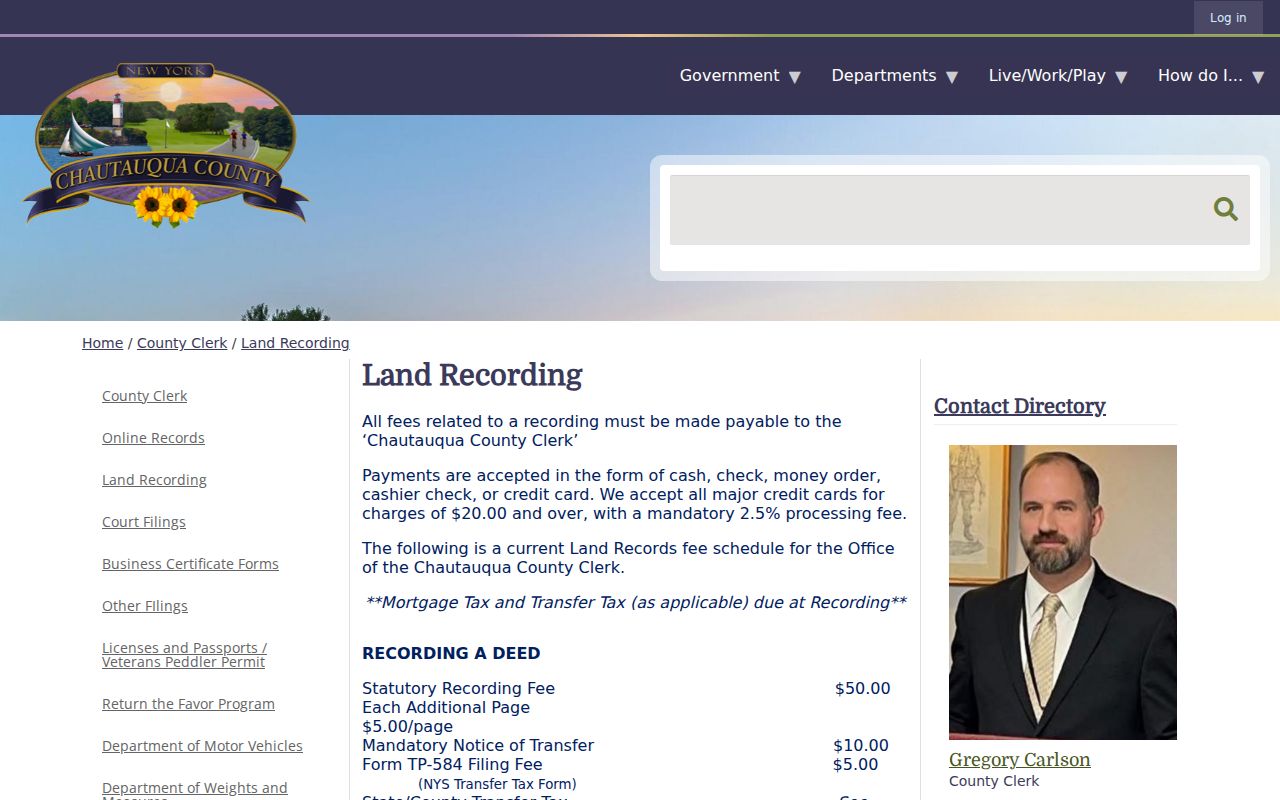
Come prepared before you ask the clerk. Bring the current deed reference, the former owner's spelling variants, an estimated date and any map name or legal-description clues. If a stretch of the chain stays unresolved, mark it as a gap and keep going with tax rolls, maps or estate records rather than claiming continuity you cannot prove.