
How a Chautauqua County Property Search Works
Any Chautauqua County property search works best with discipline. Write down the parcel identifier, municipality, and date. The exact record label matters too, because offices name the same parcel differently. Then confirm the finding with the office that keeps the underlying record, since a portal lead is never a certified instrument, a licensed survey, or a title examination.
- enter the address in the ASSESSOR PORTAL NAME
- open the parcel to see owner, value, and the parcel number
- carry the owner name or parcel to the recorder's deed index
- check the tax roll and the GIS map for the same parcel
- order certified copies of any recorded document
What a Chautauqua County Property Record Shows
Chautauqua County property records vary by office. An assessor entry, a clerk deed index, and a GIS map can each describe the same parcel in different words. Save the identifier, municipality, and label. No index entry or map replaces a certified instrument, licensed survey, or title examination, so the office that keeps the record always gets the final word.
| Owner of Record | Current owner name(s) |
|---|---|
| Situs / Mailing Address | Property address vs owner mailing address |
| Parcel Number (APN) | Format and what it keys |
| Assessed / Market Value | Values shown and the year |
| Legal Description | Lot/block or metes and bounds |
| Last Sale | Date, price, recording reference |
One record tells one piece. The assessment describes value, the tax roll names the administrative owner, and the deed records the transfer itself. Note the source date every time. Confirm anything important with the office holding the underlying instrument, because an online summary is no substitute for a certified record, survey, or title examination.
Search by Address, Owner, or Parcel
Chautauqua County offers three ways in. You can search by street address, by owner name, or by tax-map parcel number. Each key pulls slightly different results. Whatever you use, carry the parcel identifier, municipality, source date, and exact record label through the search, then verify the result with the office that keeps the record before relying on it.
| Search Key | Best For | Where It Works | Watch Out |
|---|---|---|---|
| Address | A specific property | ASSESSOR / GIS | Renumbered streets |
| Owner name | All property one person owns | ASSESSOR / RECORDER | Trusts, LLCs, same names |
| Parcel number | Exact record match | All portals | Reformatting between offices |
Not a title search. Use public records for lawful parcel research and verify the result with the responsible custodian; never use owner information to harass or harm anyone.
Carry the Chautauqua County Parcel Key Through Every Search
A strong Chautauqua County property search starts with three keys. They are address, owner name, or tax-map number. The address is best for discovery. It is not the title key. Save every close match and compare location address, municipality, SWIS, and ZIP before narrowing down. Start owner searches with the record's own spelling, then follow surname and entity-name variants. The tax-map number is usually the best exact key. Local punctuation and leading zeroes matter.
The local record set exposes both new and old identifiers. One sample bill pairs the formatted number 062801-262.15-3-18.2 with a long numeric key. PHD also accepts patterns such as 1.-1-12 and partial entries such as 1.-1-. Preserve PRKEY, PRKEYOLD, SWIS, roll year, and the returned owner label. A split or merger mints a new parcel number. Older deeds may keep the parent description anyway.
Open the Chautauqua County Search and Parcel Report
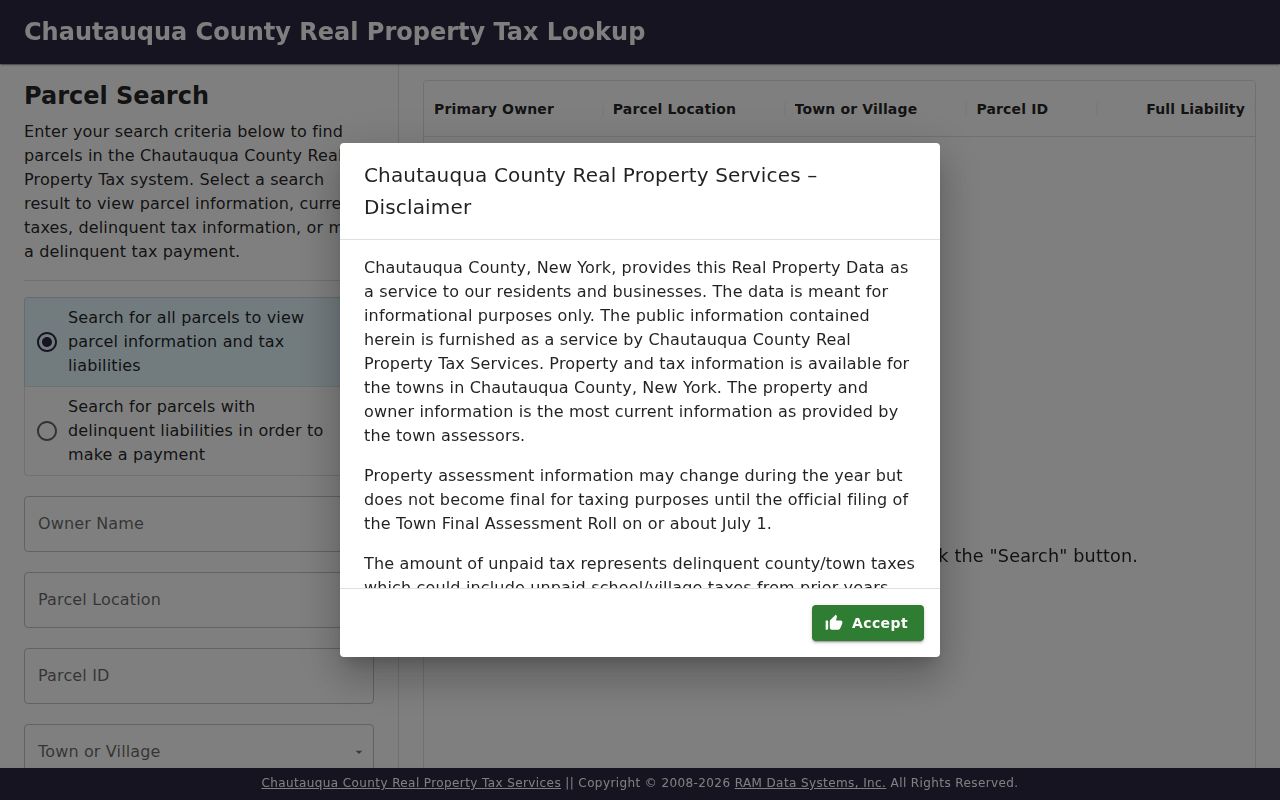
The county's Property Tax Lookup is the official search application.
Every field in the report matches the official record. The Parcel History Database report ties the current owner to parcel history and deed references.
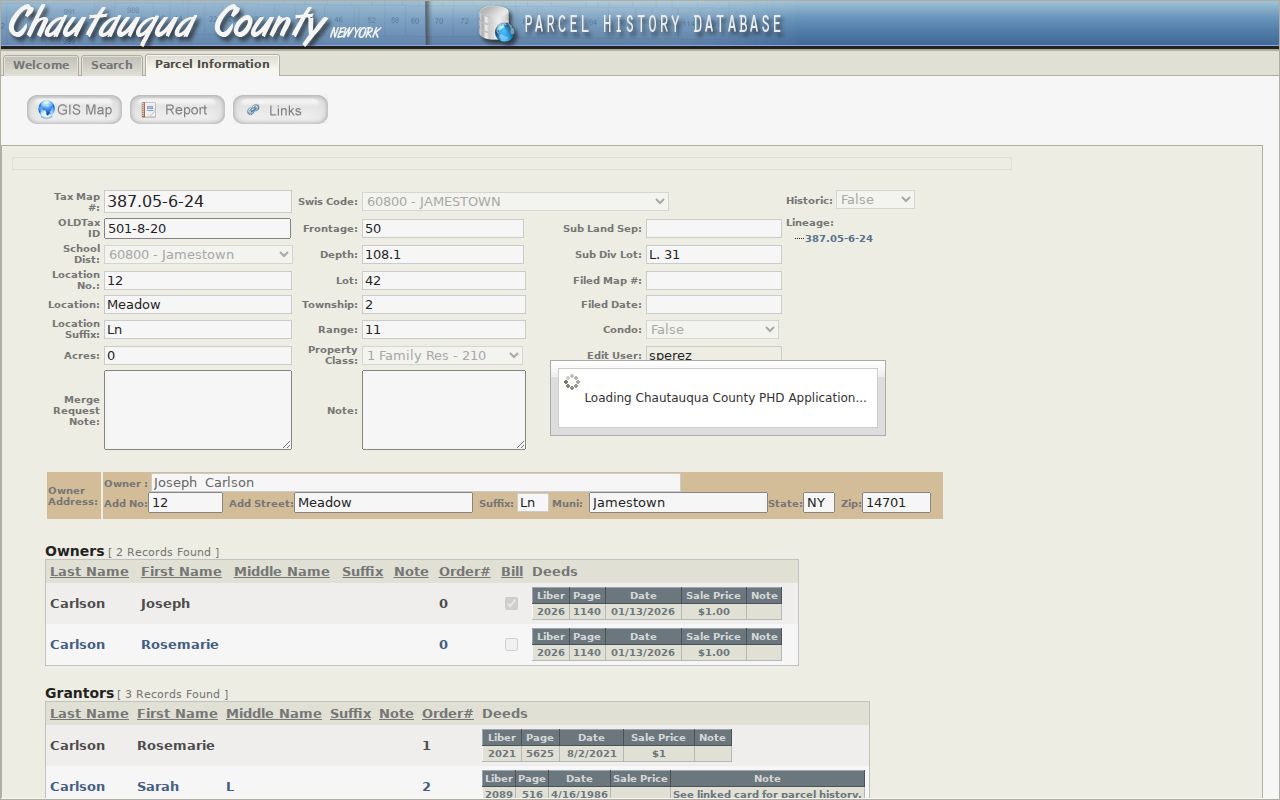
Note: Record the visible update date and roll year before you compare a recent transfer with the newest deed.
Run a Chautauqua County Property Search by Address
Type the address exactly as it stands. Keep the direction prefix and the street suffix intact. Then run a Chautauqua County property search in the Parcel History Database or the Parcel Viewer. Review every close match instead of the first one. One street address can sit across several tax parcels, especially with condominiums or split lots. So compare the returned location address, municipality, ZIP and parcel geometry before committing to a candidate. If nothing comes back, try an older spelling. Then try a neighboring municipality, the owner name, or a partial tax-map number.
Once a parcel is chosen, record its details. Note the formatted parcel ID, PRKEY or old key, SWIS, Current Owner and Roll_Year. Open the tax information, ownership history and property-detail links from the parcel popup where offered. Keep whatever update date the screen displays. PHD says it updates weekly, but an older timestamp can still appear. So trust the date shown rather than an assumption.
Remember that an address is only the discovery key, not the title key. Carry the parcel identifier and legal-description clues into the County Clerk index next. Compare the newest deed's grantee, recording date and description against the administrative owner field. That final check stops a similarly named street. A city/town mismatch or a recently transferred parcel will not slip through either.
Search Chautauqua County by Owner Without Merging Names
Start with the spelling on the assessor or PHD record. If that fails, work through surname-first-name variants, initials, dropped punctuation, and full legal entity names. A trust, estate, or LLC can appear under a name quite unlike the person who signed the deed. Common surnames are worse. They return parcels across many municipalities. So a name alone is never a safe match for Chautauqua County property records.
Check each candidate against municipality, SWIS, location address, mailing address, and parcel number. The mailing line is just where tax notices go. It may be neither the property address nor the owner's residence. It also says nothing about occupancy. When an entity holds the parcel, the New York Department of State business database helps confirm its recorded name and status. It still does not replace the deed or prove beneficial ownership of the real estate.
PHD owner searches offer exact-match toggles and a top-results cap. Those controls change what any list means. A capped list never proves it holds every parcel tied to a name. Record your query spelling and settings. Then verify the chosen parcel through its unique tax-map key.
Use Chautauqua County Tax-Map Numbers as Exact Keys
Chautauqua County uses both new and old parcel identifiers. A sample bill shows a formatted number such as 062801-262.15-3-18.2 beside a long numeric key. PHD tax-map examples include 1.-1-12 and the partial 1.-1-. Keep the punctuation, leading zeroes, and municipality selection exactly as written. A deed, bill, or historical note may use an older format. In that case, run both keys in your parcel number search.
The GIS schema breaks the map reference into SWIS, section, subsection, block, lot, sublot, and suffix. It also exposes PRKEY and PRKEYOLD. Treat these as fixed identifiers, not generic APN labels to reformat at will. A parcel number often survives an owner change. A split or merger creates new child identifiers. Keep the parent description and every later ID when the history crosses such a change.
With the right tax-map number in hand, align the assessment roll, tax bill, parcel map, and ownership-history report. The deed itself may cite a metes-and-bounds description, great lot, subdivision lot, or recorded map. It may do so instead of repeating the tax number. Book/page, map name, and the full legal description stay essential cross-references.
Know the Access Limits of a Chautauqua County Property Search
The tax and assessment publication years do not equal the full historical holdings. Current online roll series have stated year bands, while older assessments and land records may require the Tax Department, local assessor or research room. SearchIQS requires a subscription and did not expose a verified public image cutoff. State the gap honestly and use the office fallback instead of claiming that all deeds are freely imaged online.
The Parcel Viewer can show geometry, owner labels, district overlays, imagery and links to related reports. It cannot certify title, locate a surveyed boundary or guarantee that a recent split is fully reflected. The assessment roll cannot prove possession or market value. The deed index shows what was recorded but does not rule out every unrecorded interest. A complete property search keeps these limits beside the results.
For a relied-on outcome, request the relevant recorded instrument from the County Clerk and consult an appropriate title or survey professional. For roll corrections and exemptions, use the local assessor. For the tax amount or delinquency, use the County Tax Division. Matching the question to the custodian is the last step of a sound Chautauqua County property search.
Save the access date with each result.